
How to find your easy run pace, and stop running it too fast

Your easy run pace is roughly 60 to 90 seconds per kilometre slower than your 10K race pace. If you have no race to work from, use the conversation test: you should be able to talk in full sentences without pausing for breath. Most runners reading that have just realised their easy runs are not easy.
How to find your easy run pace
- Take your 10K pace as the anchor. Use a recent 10K result, or the pace you believe you could hold for 10K today. Add 60 to 90 seconds per kilometre to get a starting easy pace.
- Test it with a conversation. Ten minutes into the run, say a full sentence out loud. If you have to break it up to breathe, slow down by 15 seconds per kilometre and try again.
- Check your heart rate against the effort. Easy running usually sits between 60 and 70 percent of maximum heart rate. Treat a reading above that as a signal to slow down rather than proof you are unfit.
- Hold it for a full week. Run every easy run at that pace for one week without exception. The first two feel wrong. The fourth feels normal, and your hard session that week will be faster.
Three ways to check you are going easy enough
The conversation test is the oldest and still the most reliable. At easy pace you can hold a normal conversation in complete sentences. Not gasped fragments between breaths, sentences. If you are running alone, say something out loud and listen to how it comes out.
The pace method needs a reference: take your 10K pace and add 60 to 90 seconds per kilometre. A 50 minute 10K runner is at 5:00 per kilometre, so easy sits somewhere between 6:00 and 6:30. That range is wide on purpose, because easy pace changes with heat, sleep and how much you ran yesterday.
Heart rate works if you know your actual maximum rather than the number an equation guessed. Easy running lands between 60 and 70 percent of it. The catch is that heart rate lags behind effort by a minute or two and climbs on hills and in heat, so use it to confirm what your breathing is already telling you.
Why the grey zone costs you
The failure mode is not running too hard. It is running everything at the same medium effort: a bit too fast to recover from, nowhere near fast enough to stress the systems that make you quicker. Weeks go by, the training feels honest, and nothing improves.
Easy running is doing real work. It builds capillary density and mitochondria, it teaches your legs to handle repeated impact, and it lets you get to Tuesday fresh enough to run Tuesday properly. None of that happens if every run leaves a small debt behind.
A useful check on your own log: if your easy days and your hard days are within twenty seconds per kilometre of each other, you do not have easy days and hard days. You have one pace.
How to actually slow down
Knowing the number and running the number are different problems. The first kilometre sets the tone for the whole run, so start it deliberately slower than feels right and let the pace settle upward if it wants to.
Running with someone slower helps, as does leaving the watch on total time rather than current pace. If you keep drifting, put a hard ceiling on it: pick a pace, and treat going faster as a failed session in the same way you would treat missing an interval target.
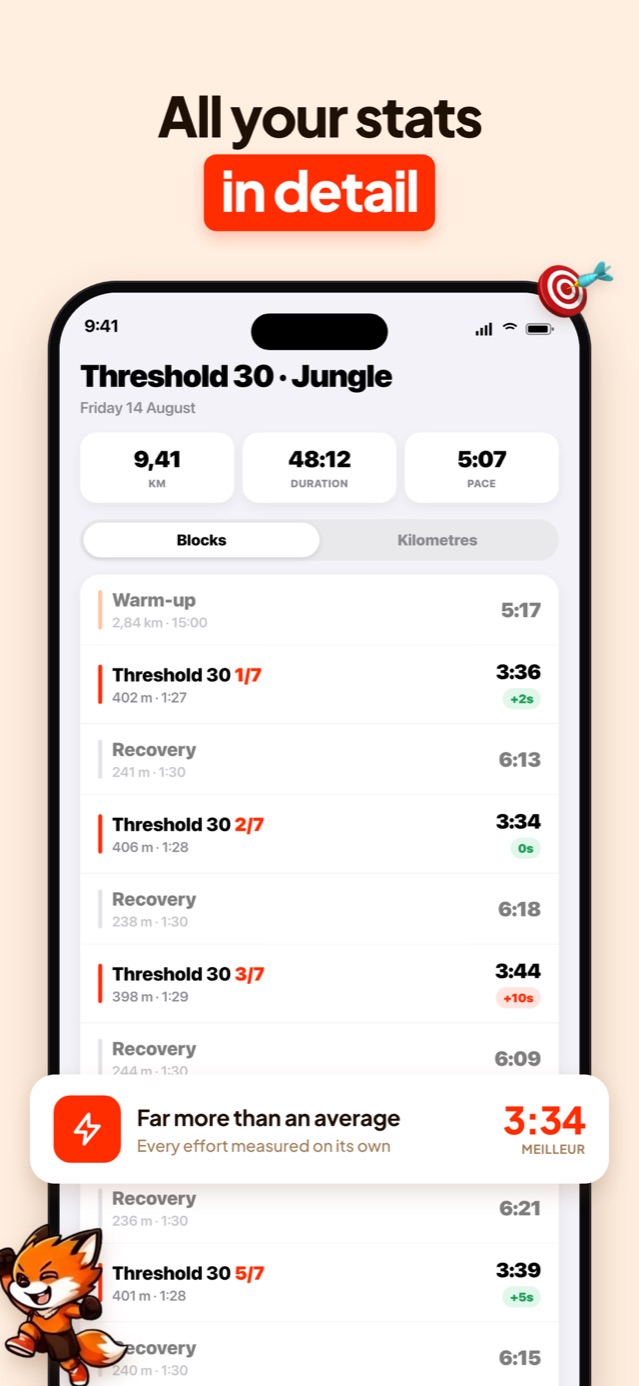
Samado handles this by prescribing the easy blocks explicitly, with their own pace target and their own audio cue, so a recovery jog is a thing you are being asked to run rather than a gap between the parts that count.
What easy pace is not
It is not a fixed number you find once. It moves with your fitness, and it moves within a single week depending on what you ran two days ago. Treat it as a range and let the day decide where in that range you land.
It is also not the same as your recovery jog between repetitions, which is usually slower again. And it is not something to be embarrassed about. Nobody has ever looked at a training log and been impressed by fast easy runs.
Frequently asked
Is it normal for easy pace to feel embarrassingly slow?
Yes, and it is the most common reason people abandon it. The discomfort is social rather than physical. Give it four runs before you judge it, by which point the pace stops feeling artificial and your hard sessions will already have improved.
Should I run easy by pace or by heart rate?
By effort first, with pace as a guardrail. Heart rate is useful confirmation but it lags behind effort and climbs in heat and on hills, so it will tell you to walk up a gentle incline you could comfortably jog.
Keep reading
Heart rate zones for running, explained
What the five running heart rate zones are for, how to set yours without a lab test, and why the zones your watch shipped with are probably wrong.
Read the guide
What is threshold pace in running, and how do you hit it?
Threshold pace is the effort you could race for about an hour. How to work yours out from a race, a time trial or heart rate, and how to run the session.
Read the guide
How to train for a 10K in 8 weeks
An eight week 10K build for runners who can already run 40 minutes: what each week contains, the three sessions that do the work, and how to taper for race day.
Read the guideRun the session instead of reading about it
Samado turns all of this into blocks with pace targets, calls them out while you run, and scores every repetition afterwards.
Download on the App Store