
What is threshold pace in running, and how do you hit it?

Threshold pace is the fastest pace you could hold for about an hour of racing. It feels comfortably hard: you can get three or four words out at a time, not a full sentence, and you finish a session knowing you had one more repetition in you rather than five. Everything below is about finding that number for yourself and then actually running it.
How to work out your threshold pace
- Start from a recent race. Take your most recent race result. Threshold pace sits roughly 10 to 15 seconds per kilometre slower than 10K race pace, or 5 to 10 seconds per kilometre faster than half marathon pace.
- Or run a 20 minute time trial. Warm up for 15 minutes, then run 20 minutes as hard as you can hold evenly. Take the average pace and add about 5 seconds per kilometre.
- Sanity check it against heart rate. Threshold effort usually lands between 83 and 88 percent of maximum heart rate. A repetition that starts at 84 percent and finishes at 89 percent was paced about right.
- Run it in blocks, not all at once. Break the work into repetitions of 5 to 10 minutes with 60 to 90 seconds of easy jogging between them. Total threshold time of 20 to 40 minutes is a normal session.
- Adjust every few weeks. When a threshold session stops feeling comfortably hard and starts feeling easy, take 3 to 5 seconds per kilometre off the target and try again.
How to work out your threshold pace
The cleanest number comes from a race you have actually run. A 10K result is close enough for most people: threshold pace sits roughly 10 to 15 seconds per kilometre slower than what you raced. If your most recent race was a half marathon, go the other way and take 5 to 10 seconds per kilometre off it.
Without a recent race, a 20 minute time trial does the job. Warm up properly, then run 20 minutes as hard as you can hold at an even pace, and add around 5 seconds per kilometre to the average. The addition matters. Twenty minutes flat out is slightly faster than true threshold for most trained runners, and taking the raw number would leave you racing every Tuesday.
Heart rate is a check rather than a target. Threshold effort usually sits between 83 and 88 percent of maximum, and it drifts upward through a long repetition as you warm up and fatigue. If you start a 10 minute rep at 84 percent and finish it at 89 percent, you paced it correctly. If you were at 90 percent inside the first two minutes, you went out too fast.
What a threshold workout actually looks like
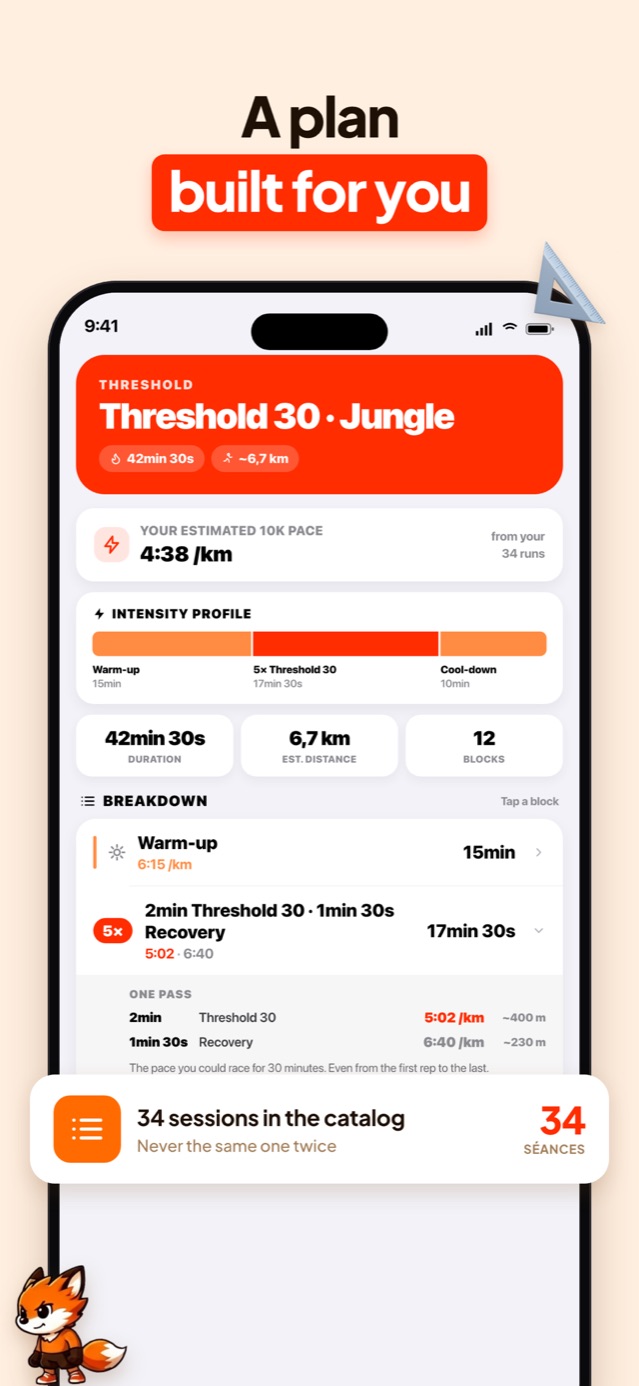
The two common shapes are a continuous tempo run and a set of broken repetitions. A continuous version is 20 to 40 minutes at threshold with a warm-up and a cool-down either side. The broken version splits that same total into repetitions of 5 to 10 minutes with 60 to 90 seconds of easy jogging between them.
Broken sessions are easier to pace and easier to finish, which is why most structured plans lean on them. The recovery is deliberately short. It is there to let your form reset, not to let your heart rate come all the way down, so the physiological effort accumulates across the whole session.
Total volume at threshold is the number that matters. Twenty minutes is a light session, forty is a substantial one, and beyond about sixty you have stopped doing threshold work and started racing.
The mistake that ruins most threshold sessions
People run them too fast. Threshold is the pace that responds worst to enthusiasm, because five seconds per kilometre too quick does not feel like much in the first repetition and feels like a great deal in the sixth. The session then stops being threshold work and becomes a badly paced interval session that leaves you too tired for the rest of the week.
The fix is knowing where you are inside the current repetition rather than at the end of it. An average pace for a 45 minute run that contained seven repetitions and seven recoveries is a meaningless number. What you need is the pace for this repetition, compared against its target, while there is still time to change it.
Where threshold fits in a training week
One threshold session a week is enough for most people running three to five times. Two is possible in a heavier block, but they need to be separated by at least two days and at least one of them should be on the shorter side.
Everything else in the week should be genuinely easy. Threshold work is only worth anything if the runs around it are slow enough to let you recover, which is the part most amateur runners get wrong long before they get their threshold pace wrong.
Frequently asked
Is threshold pace the same as tempo pace?
In everyday use they are the same thing, though coaches split hairs about it. "Tempo" usually describes a continuous run at that effort, while "threshold" describes the physiological marker itself, which you can train continuously or in repetitions.
How often should I run threshold sessions?
Once a week suits most runners on three to five sessions. In a heavier block you can run two, separated by at least two days, with one of them shorter than the other.
Keep reading

Interval training for runners: how to structure a session
The four numbers that define an interval session, how many repetitions to run, how long recovery should be, and where intervals belong in a training week.
Read the guide
Heart rate zones for running, explained
What the five running heart rate zones are for, how to set yours without a lab test, and why the zones your watch shipped with are probably wrong.
Read the guide
How to improve your 5K time
Work out where your 5K is losing time, then fix it: short repetitions to raise your top end, threshold work to raise the floor, and a pacing plan for the race.
Read the guideRun the session instead of reading about it
Samado turns all of this into blocks with pace targets, calls them out while you run, and scores every repetition afterwards.
Download on the App Store